
Last Updated on August 21, 2026 by Bianca Clinton, Partner at Clinton Consultancy – Qualified Solicitor (Ghana, England & Wales)
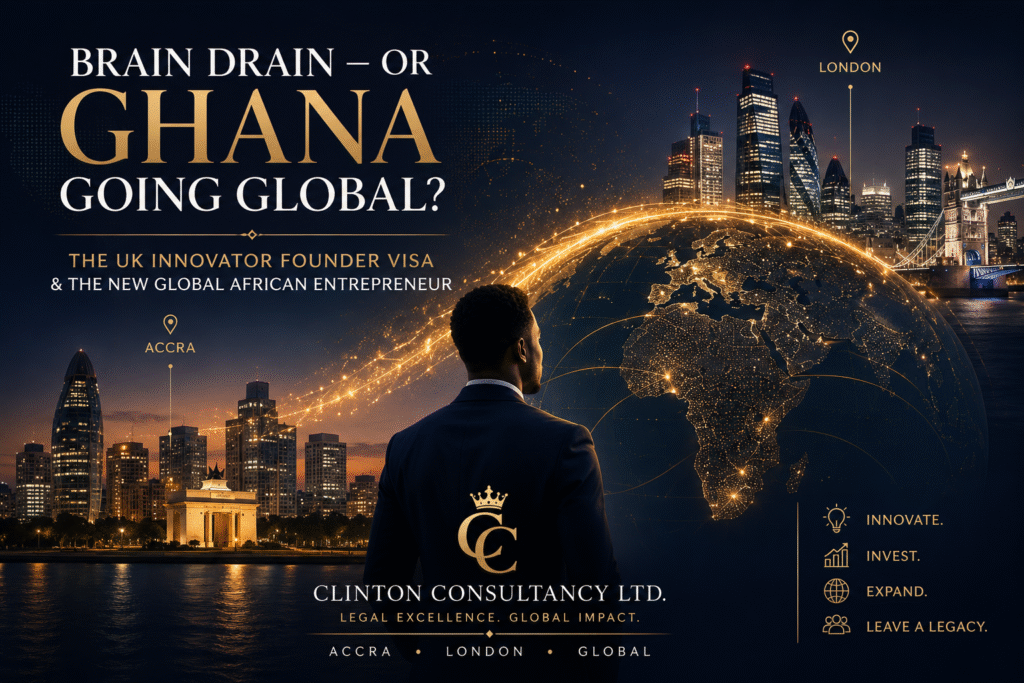
The UK Innovator Founder Visa: Brain Drain — or Ghana Going Global?
There is a question I believe we need to ask more confidently in Ghana.
When a Ghanaian entrepreneur takes their ideas, expertise and ambition into an international market, have we lost them — or has Ghana gained a global ambassador?
For decades, African migration has often been discussed through the language of brain drain: our doctors leave, our academics leave, our professionals leave, our entrepreneurs leave. The concern is legitimate. A country that invests in talented people but cannot create sufficient opportunities for them risks losing skills that are desperately needed at home.
But I believe the emergence of the global African entrepreneur requires us to think differently.
The UK’s Innovator Founder visa presents an interesting example.
It is not simply a route for somebody who wants to leave Ghana and find employment elsewhere. Broadly speaking, it is aimed at entrepreneurs seeking to establish an innovative business in the United Kingdom, with the business proposition expected to satisfy requirements around innovation, viability and scalability, alongside the other applicable immigration and endorsement requirements.
That distinction matters.
Because perhaps the more interesting question is not:
“Why are you leaving Ghana?”
It is:
“How can you use Britain as another platform from which to build something that benefits Ghana, Africa and the wider world?”
I don’t believe African ambition should have geographical boundaries
As a Ghanaian lawyer working with businesses, investors and entrepreneurs, I have become increasingly convinced that we must stop thinking about African success as though it has to choose between being African or international.
It can be both.
A Ghanaian founder can establish operations in London while employing people in Accra.
A technology entrepreneur can raise international capital while developing solutions for African consumers.
A Ghanaian professional can build relationships in Britain, Dubai or the United States and bring those relationships into businesses operating across Africa.
A founder can earn in international markets, invest at home and introduce Ghanaian products and intellectual property to customers who may never previously have encountered them.
That isn’t necessarily brain drain.
Done properly, it can become brain circulation.
The old model was migration. The new model can be expansion.
This is the distinction I want ambitious Ghanaian entrepreneurs to understand.
Your objective does not necessarily have to be:
“I need to leave Ghana to become successful.”
I would rather see our entrepreneurs thinking:
“I am building from Ghana, and the world is my market.”
That is an entirely different psychology.
London can be a market.
Accra can remain a base.
Dubai can become a relationship hub.
America can become a source of customers, investors or strategic partnerships.
And Africa can remain integral to the founder’s identity, commercial strategy and eventual legacy.
What actually is the Innovator Founder route?
The Innovator Founder route is intended for people seeking to establish an innovative business in the UK.
It is not enough simply to have money or to want to open an ordinary business.
The business proposition needs to satisfy the relevant requirements, including being assessed against the concepts of innovation, viability and scalability, and applicants generally require endorsement from an approved endorsing body.
That makes the commercial thinking behind the application particularly important.
A prospective founder should therefore be asking:
What problem am I solving?
What is genuinely different about my proposition?
Is there a credible market for it?
Can the business realistically be delivered?
Can it grow beyond a very small operation?
Why is the UK an appropriate market from which to build it?
And, for the Ghanaian entrepreneur, I would add another:
How can international expansion strengthen rather than sever my relationship with Ghana and Africa?
The opportunity for Ghana’s high-net-worth entrepreneurs
I think this is particularly interesting for established Ghanaian entrepreneurs.
We have businesspeople who possess capital, relationships and decades of commercial experience but whose businesses remain geographically concentrated.
Internationalisation can change that.
The opportunity isn’t merely obtaining another residence status.
The much bigger prize can be building an internationally structured enterprise.
Imagine a Ghanaian founder who builds intellectual property in Britain, operates part of the business from Ghana, employs Ghanaian professionals, attracts international investment, sells into several markets and ultimately brings knowledge and capital back into additional African ventures.
That founder hasn’t necessarily abandoned Ghana.
They may have dramatically expanded Ghana’s economic footprint.
But we shouldn’t romanticise migration either
There is another side to this argument.
Not every departure becomes brain circulation.
If our most talented people continually leave because they cannot find infrastructure, financing, professional opportunities or confidence in domestic institutions, Ghana genuinely loses something.
And international expansion shouldn’t become an excuse for entrepreneurs to disengage from the communities that developed them.
That is why I believe intentionality matters.
If you’re considering international expansion, ask yourself what Ghana retains.
Could some of your staff remain here?
Could part of your technology or administration be developed here?
Could Ghana become your West African headquarters?
Could international revenues finance African expansion?
Could you mentor another Ghanaian entrepreneur?
Could your international network eventually introduce capital into Ghana?
Could your success make somebody elsewhere say:
“I want to invest in Ghana”?
That is where mobility becomes economically interesting.
From brain drain to brain gain
Africa does not need to hide its brightest people from the world in order to retain them.
We need to create a generation whose success connects the world back to Africa.
I want to see more Ghanaian founders capable of walking confidently into boardrooms in London, Accra, Dubai and New York without believing that they have somehow changed identity each time their plane lands.
You remain Ghanaian.
You simply become global.
And there is considerable power in that distinction.
My message to Ghanaian entrepreneurs
If you have spent years building expertise, don’t automatically limit the commercial value of that expertise to the country in which you developed it.
Think bigger.
But think strategically.
Don’t pursue an immigration route simply because it sounds attractive.
Build a business case.
Understand the regulatory requirements.
Protect your intellectual property.
Understand your capital requirements.
Investigate your market.
Build proper financial projections.
Obtain appropriate professional advice.
And above all, ask yourself what you are actually trying to build.
Because the visa should never be the business strategy.
The business should be the strategy.
The visa is potentially one mechanism that enables the founder to execute it.
That is an important distinction—and one I believe serious entrepreneurs should understand from the beginning.
Ghanaian. African. Global.
I want us to become increasingly comfortable putting those three words together.
I do not believe our next generation of entrepreneurs should have to choose between contributing to Africa and participating in the global economy.
We should be producing businesses capable of doing both.
So when somebody asks whether the Innovator Founder route contributes to Africa’s brain drain, my answer is:
It can.
But it can also contribute to something far more exciting.
If approached intelligently, ethically and strategically, international mobility can help create globally connected Ghanaian founders who accumulate expertise, relationships, intellectual property and capital—and maintain a deliberate bridge back to Ghana.
The challenge for us is therefore not simply to stop talented Africans from leaving.
It is to make sure that wherever African talent goes, Africa remains connected to what it builds.
That is not brain drain.
That is Ghana going global.
This article is general commentary and does not constitute immigration or legal advice. Eligibility and immigration requirements depend upon individual circumstances and the rules applicable at the time of application.
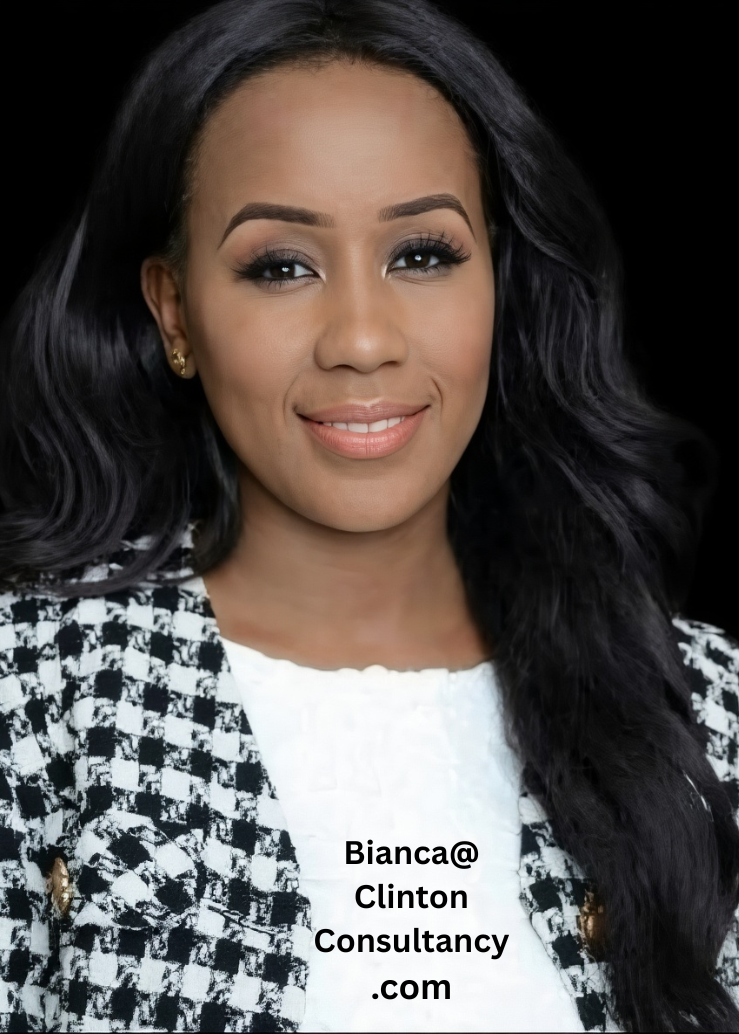
Bianca Akweley Clinton is an internationally recognised legal practitioner, dual-qualified as a Solicitor of England & Wales and a Barrister-at-Law in Ghana, with extensive experience advising clients across Africa and internationally on complex legal, corporate, and cross-border matters.
She is a Partner at The Law Office of Clinton Consultancy, an award-winning international law and advisory firm providing legal and strategic solutions to African and global clients in areas including shipping and maritime law, corporate and commercial transactions, investment structuring, mergers and acquisitions, immigration law, dispute resolution, regulatory compliance, due diligence, and international business advisory services.
Bianca has been recognised for her outstanding contribution to the legal profession as the recipient of the prestigious African Legal Icon Award by the Heritage Foundation, honouring her commitment to legal excellence, professional integrity, and the protection of clients’ interests across multiple jurisdictions.
Recent awards won by Bianca include:
December 2025 — Outstanding Woman in Corporate Risk and Strategic Advisory — Ghana Business Forum.
April 2026 — African Legal Icon — African Heritage Awards, Accra.
May 2026 — Clinton Consultancy received two African Excellence Awards: Best Global Cross-Border Legal Advisory Firm 2026 and Legal Excellence in Corporate Law 2026.
June 2026 — Global 100 – 2026 Awards: The Law Office of Clinton Consultancy recognised as Leading Firm in Law Practice in Ghana for 2026.
Under her leadership, The Law Office of Clinton Consultancy has received international recognition, including being named Leading Firm in Law Practice – Ghana at the Global 100 Awards 2026, alongside numerous other national and international recognitions for excellence in legal practice, strategic advisory work, and cross-border business support.
Through BiancaClinton.org, Bianca shares legal insights, professional commentary, and thought leadership designed to educate, inform, and support businesses, investors, institutions, and individuals navigating legal and commercial opportunities worldwide.
Through Clinton Consultancy’s expanding international network, the firm proudly serves clients through its flagship offices and operational presence in Ghana, Nigeria, Sierra Leone, the United Kingdom, South Africa and across global markets.
Contact Bianca Clinton Directly
📧Email: Bianca@ClintonConsultancy.com
🇬🇭 Ghana Office: +233 59 261 1535
🇬🇧 United Kingdom Office: +44 7425 700 696